NovaStyles.
Research Strategy Solutions Product Back to Portfolio
Portfolio / NovaStyles
Product Design Web Platform 2025

NovaStyles

Designing a multi-intent platform for interiors, construction & e-commerce

NovaStyles had a basic informational website. They needed a platform that could serve three distinct user intents — interior design, construction, and product e-commerce — without forcing everyone through the same funnel. I led the research, strategy, and design to transform it into a scalable, conversion-focused ecosystem.

3 Service Verticals
30+ Screens
120+ Reviews Analyzed
Sole Designer
Secondary Research Competitor Analysis User Reviews Information Architecture UI Design Responsive Design E-commerce UX
NovaStyles — Interior Design Page
NovaStyles — Home Page Design
NovaStyles — Construction Page
01 Research
02 Strategy
03 Solutions
04 Outcome

The problem behind the brief

NovaStyles is a Bangalore-based company offering interior design, construction, and premium home products. They had a basic informational website, but it wasn't converting visitors into leads. The site treated every user the same, regardless of whether they wanted a full home interior, a construction estimate, or just a wallpaper.

What existed

A basic website listing services. No clear user journeys, no estimation tools, no intent-based navigation. Every user landed on the same generic page regardless of what they were looking for.

What I delivered

A complete multi-intent platform with competitor research, user review analysis, information architecture, intent-based navigation, guided estimation flows, tiered pricing models, e-commerce integration, and 30+ responsive screens across desktop and mobile.

How the home interiors market works in India

Before designing anything, I studied the top competitors in India's home interiors space. I wanted to understand what they do well, where users feel frustrated, and where there's a clear gap NovaStyles can own.

Competitor Strengths Weaknesses
Strong estimation tool, clear pricing tiers, modular kitchen focus. Good trust signals with project timelines. Limited to modular interiors. No construction. Poor mobile experience for complex flows. Users report hidden costs not reflected in estimates.
Large designer network, magazine-quality inspiration content. End-to-end project management dashboard for clients. Overly complex onboarding. Users report long response times. No construction services. Premium pricing alienates budget-conscious users.
Factory-built modular approach. Competitive pricing. Good at communicating manufacturing quality. Limited geographic coverage. No e-commerce for standalone products. Website feels catalog-like rather than service-oriented.
All three verticals in one platform — interiors, construction, AND e-commerce. Guided estimation for each. Intent-based navigation. Newer brand — needs strong UX to compete on trust and usability against funded competitors.

Every competitor focuses on a single vertical — either interiors OR construction OR products. NovaStyles' opportunity is to be the one platform that combines all three, but only if the UX can handle multi-intent navigation without overwhelming users.

What real users are saying about competitors

I analyzed 120+ reviews from Google Play Store, App Store, and platforms like MouthShut, Trustpilot, and Google Business reviews for HomeLane, Livspace, and DesignCafe. Instead of guessing user pain points, I extracted them directly from real user feedback.

HomeLane Play Store & Google Reviews
★★★☆☆ 3.2 avg

"Hidden costs everywhere" — Users report that the initial estimate shown online is significantly lower than the final bill. Add-ons, civil work charges, and material upgrades inflate costs by 30-40%.

"Post-sales nightmare" — Once the project starts, designer responsiveness drops. Users feel abandoned during execution phase. Project managers change mid-project.

"Good initial experience" — The estimation tool and 3D visualization make a strong first impression. Users appreciate seeing a price before committing to a meeting.

Livspace App Store & Trustpilot
★★★☆☆ 2.9 avg

"Takes forever to get a response" — Multiple users report 3-5 day wait times after submitting interest. By then, they've already contacted 2-3 other companies.

"Premium pricing, average quality" — Users feel the brand premium doesn't translate to execution quality. Material choices are limited in lower-tier packages.

"Great design inspiration" — The magazine-style content and project galleries help users visualize what's possible. Strong brand trust from content marketing.

DesignCafe Google Reviews & MouthShut
★★★★☆ 3.6 avg

"No construction services" — Users who need both interiors and construction have to find separate contractors for civil work. No integrated offering.

"Transparent pricing" — Factory-built modular approach gives consistent pricing. Users appreciate knowing the exact cost upfront with fewer surprises.

"Quality of materials is good" — Users consistently praise the material quality. The manufacturing-first approach builds confidence in durability.

67% Complained about hidden costs or pricing transparency
52% Mentioned poor post-sales communication
41% Wanted both interiors + construction from one provider
78% Valued upfront estimation before committing

Key takeaway from user reviews: Users don't just want pretty designs — they want pricing transparency, responsive communication, and the convenience of getting everything from one platform. These became the three pillars of our product strategy.

What the research told me about the product direction

01
From competitor analysis

No competitor serves all three intents — that's the real opportunity

HomeLane does interiors. DesignCafe does modular kitchens. Nobody does interiors + construction + e-commerce together. Users currently have to visit 3 different providers. NovaStyles can own the "one platform for everything home" position — but only if the UX doesn't feel like three different websites glued together.

02
From user reviews across platforms

Pricing transparency is the #1 trust signal — estimation must happen before any human conversation

67% of negative reviews across all three competitors mentioned hidden costs. Users want to see a number before they talk to anyone. The estimation tool isn't just a feature — it's the trust-building mechanism. If the first interaction asks for a phone number instead of showing a price, users leave.

03
From IA and intent mapping

Intent-based navigation is the structural foundation — not service-based

A user looking for construction and a user looking for wallpaper have completely different journeys, timelines, and decision-making processes. The navigation needs to separate these at the top level — not dump everyone on one homepage with a generic "Our Services" section.

04
From competitive pricing analysis

Tiered pricing reduces friction — users self-qualify before contacting sales

When users see "Economy / Standard / Premium" tiers with actual price ranges, they self-select into the right conversation. This reduces mismatched expectations (the #1 cause of negative reviews) and helps the sales team prioritize leads by budget level.

05
From e-commerce review analysis

E-commerce should feel like a native part of the platform — not a separate store

Competitors who offer products do it through generic Shopify-style stores that feel disconnected from their main service. NovaStyles' wallpaper and decor catalog should integrate seamlessly — the same navigation, the same design language, the same trust signals.

How the platform is structured and why

The IA was designed around user intent, not company services. Each vertical has its own entry point, its own estimation flow, and its own conversion path — but they all share the same navigation shell and design system.

Primary Navigation
Nova Interiors ↓
Nova Construction ↓
Nova Products ↓
About NovaStyles
Nova Interiors (Service Vertical)
Interior Design Landing
Estimation Step 1: Budget Tier
Estimation Step 2: Requirements
Estimation Step 3: Contact & Quote
Nova Construction (Service Vertical)
Construction Landing
Step 1: Building Type
Step 2: Plot & Area
Step 3: Room Requirements
Tiered Pricing Display
Nova Products (E-commerce)
Wall Decor & Flooring
Category Pages
Product Detail Page
Cart & Checkout
Shared Components
Unified Navigation
Get Free Estimate CTA
Footer with Service Links
Contact / Lead Form

Why this structure works: A user looking for wallpaper never has to scroll past construction content. A user needing a full home build never sees e-commerce product listings cluttering their journey. Each intent gets a clean, focused path — but the shared navigation makes cross-selling natural.

The decisions that shaped the product

Decision 01 Navigation

Intent-based mega navigation instead of a flat service list

The original website had "Services" as one nav item with a dropdown. I restructured it into three distinct nav items — Nova Interiors, Nova Construction, Nova Products — each with their own dropdown menus. This tells users immediately that the platform serves different needs, not just one.

Trade-off: More items in the navigation. But the clarity of intent separation was worth the extra nav items. Users self-route within 2 seconds instead of scrolling a generic services page.
Decision 02 Estimation

Guided estimation flow with progressive disclosure

Instead of a long form asking for all details upfront, I designed a 3-step estimation flow. Each step asks one category of questions: what type of service, what are the specifications, and what's your contact info. Users see progress ("Step 1 of 3") and can go back at any point.

Trade-off: More screens than a single-page form. But each step has lower cognitive load, and the step-by-step format builds commitment — by step 3, users have already invested effort and are more likely to submit.
Decision 03 Pricing

Tiered pricing display — Basic, Standard, Premium

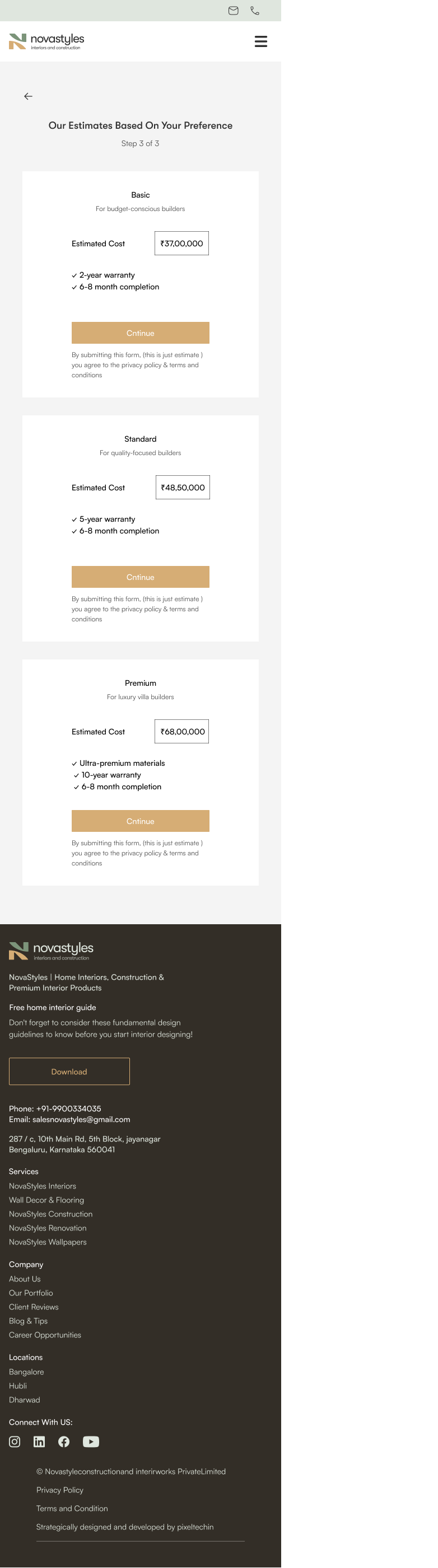
After the estimation steps, users see three price tiers with clear feature differences, warranties, and timelines. This was directly inspired by the #1 user complaint from competitor reviews: hidden costs. By showing all three tiers with real numbers, we set accurate expectations before any sales conversation.

Trade-off: Showing pricing publicly risks undercutting. But the transparency builds trust — and users who see prices and still submit their details are much higher-quality leads.
Decision 04 E-commerce

Integrated product catalog — not a separate store

The wallpaper and home decor e-commerce lives within the same platform, using the same navigation, footer, and design language. Users can browse products with the same level of detail — texture options, pricing per sq ft, and dimensional inputs for accurate pricing — all without leaving the NovaStyles ecosystem.

Trade-off: More complex development than a standalone Shopify store. But the brand consistency and cross-selling opportunities justify the investment.

Screens from the final design

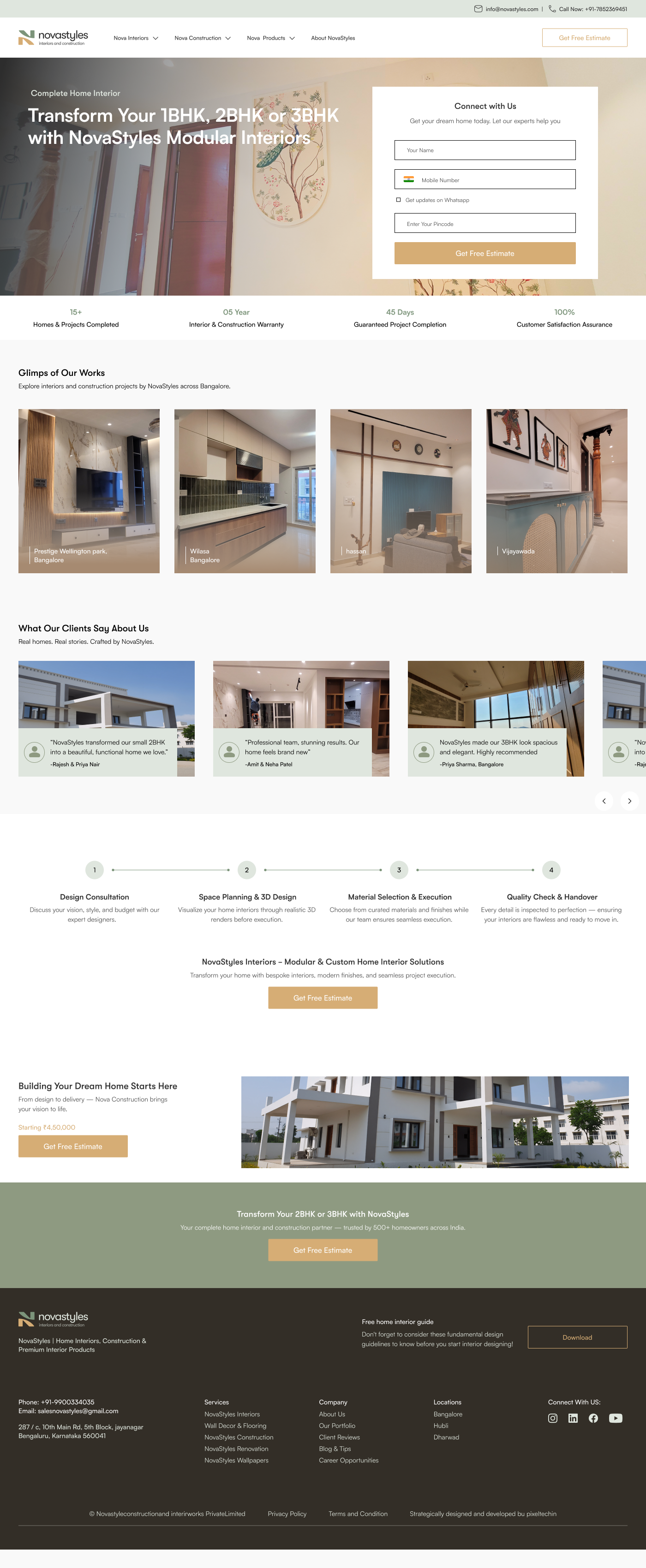
Home Page — Multi-Intent Landing

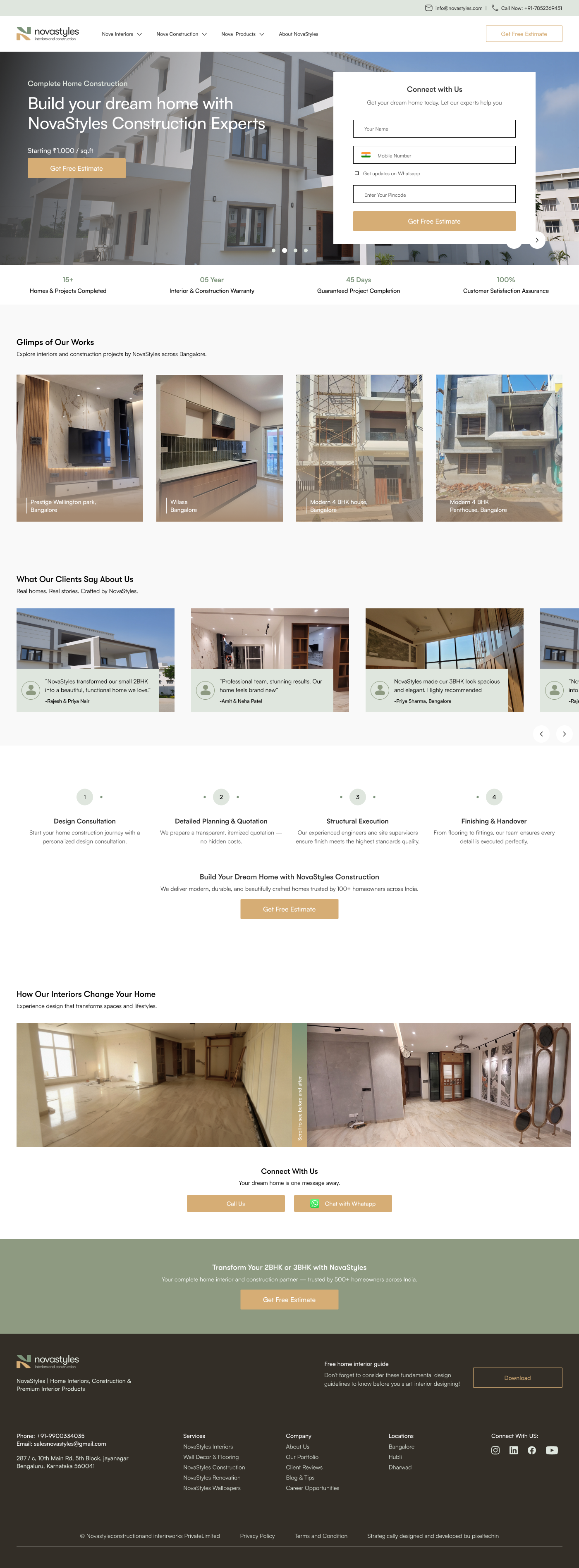
The home page introduces all three service verticals without overwhelming the user. The hero section communicates the "complete home solution" positioning, while distinct sections for interiors, construction, and products let users self-navigate based on their intent. The "Get Free Estimate" CTA is persistent across the entire platform.

NovaStyles Home Page — Desktop

Interior Design — Service Landing

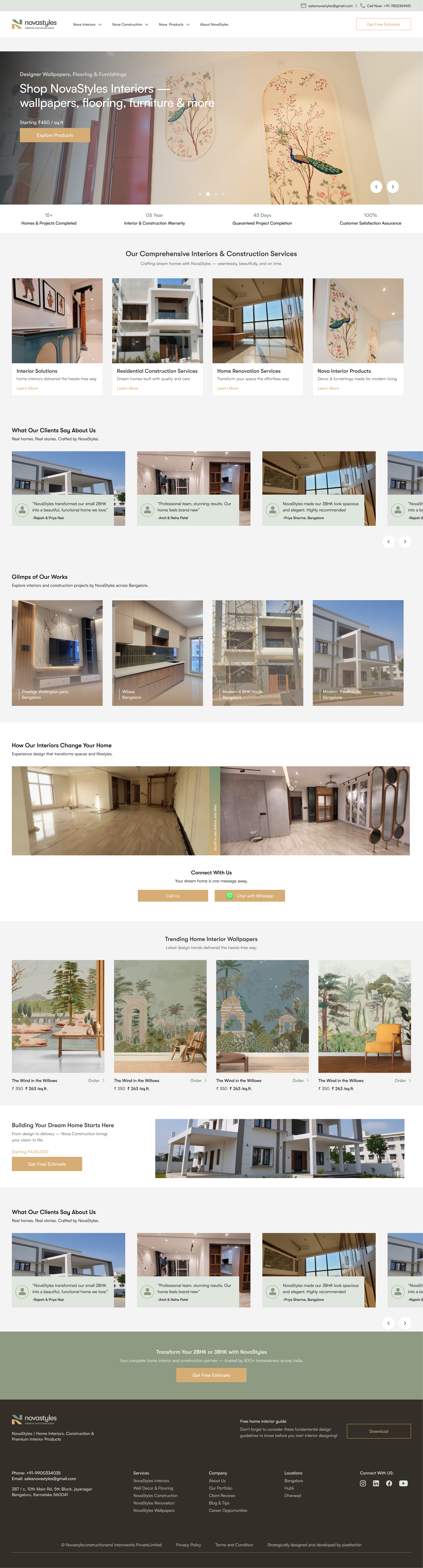
The interior design page is designed for users who already know they want interior work. It showcases portfolio projects, explains the design process, and drives toward the estimation flow. The content is structured to build confidence: portfolio → process → pricing → CTA.

NovaStyles Interior Design Page

Construction — Service Landing

The construction vertical has its own dedicated landing page with a different content structure — project showcase, service types (ground floor, duplex, G+2), and a direct path to the construction estimation flow. The design communicates reliability and scale.

NovaStyles Construction Page

E-commerce — Wall Decor & Products

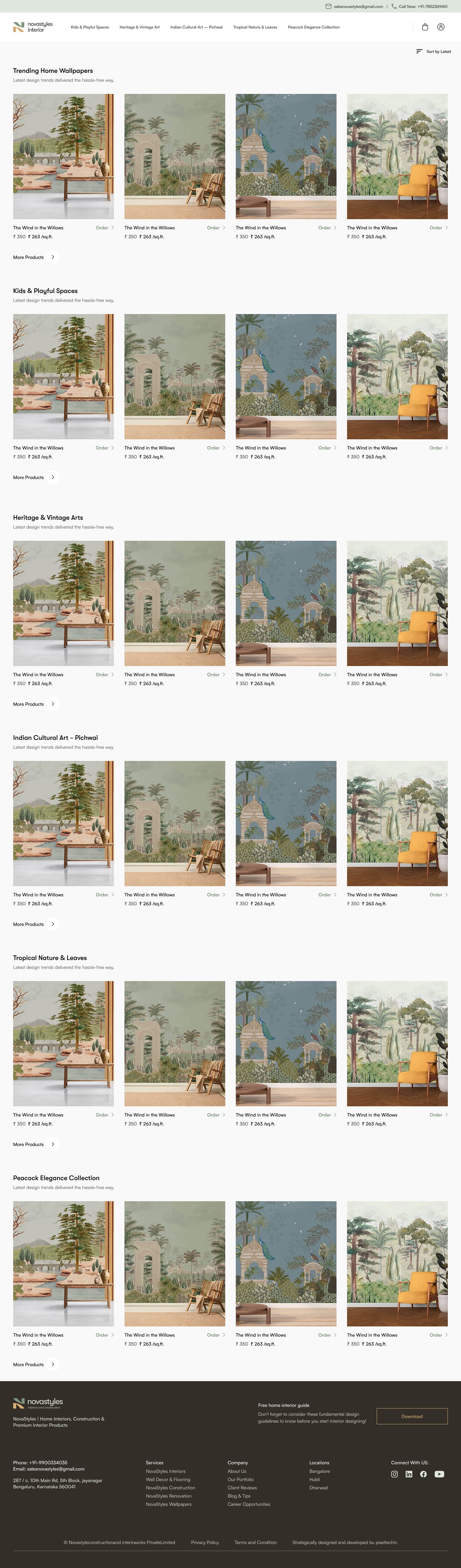
The e-commerce section lets users browse and purchase wallpapers and home decor products. Each product category is organized by design theme (Heritage & Vintage, Kids & Playful, Tropical Nature). Product detail pages include texture options, dimension inputs, and price-per-square-foot calculations — giving users accurate costs before purchase.

NovaStyles E-commerce — Product Listing

Product Detail — Wallpaper Configurator

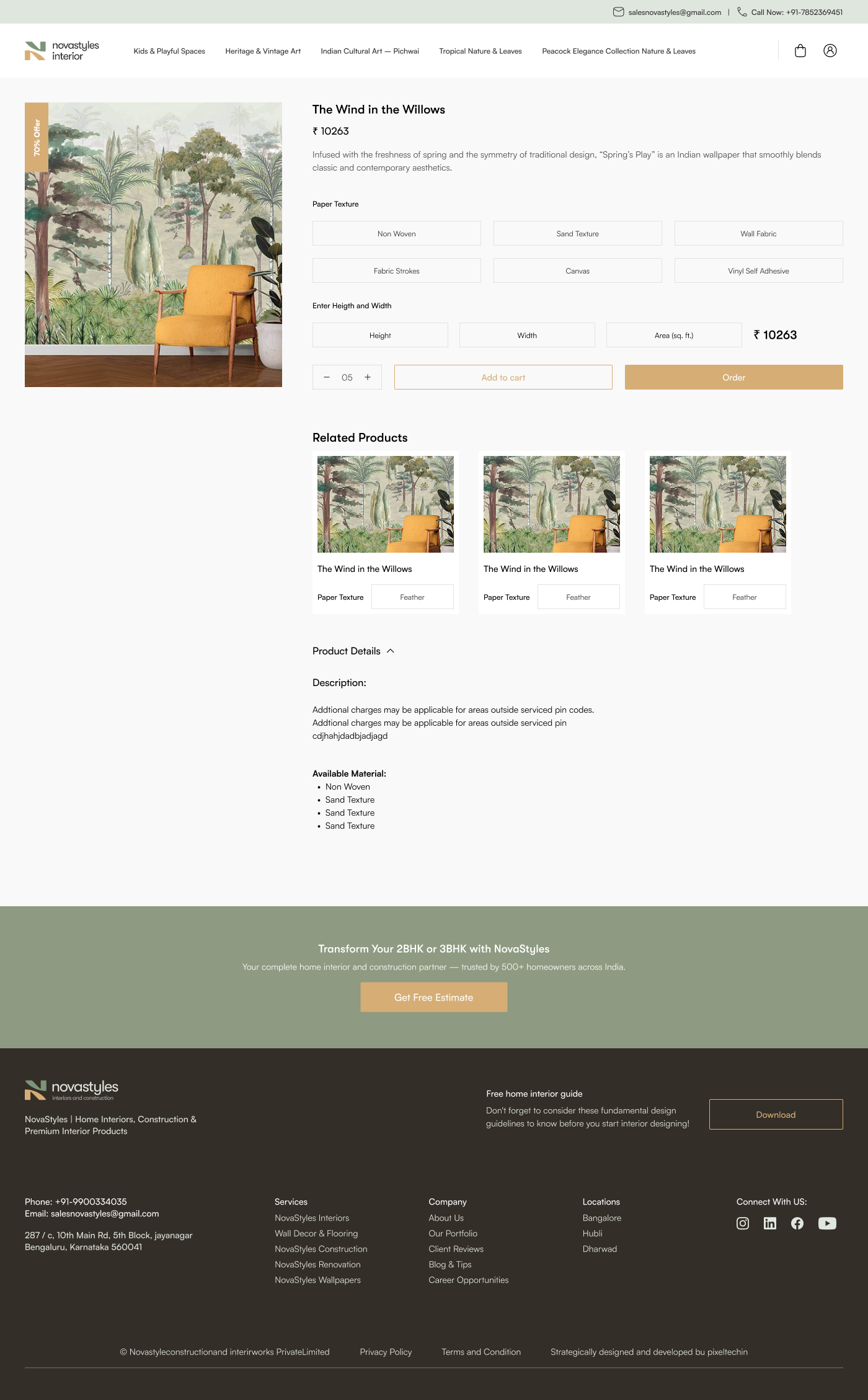
The product detail page goes beyond a basic e-commerce template. Users can select paper texture (Non Woven, Sand Texture, Wall Fabric, Canvas, Vinyl Self Adhesive), enter custom height and width dimensions, and see the total area and cost calculated in real-time. Related products are shown below to encourage browsing.

NovaStyles Product Detail — Desktop View

Estimation Flow — Guided Onboarding

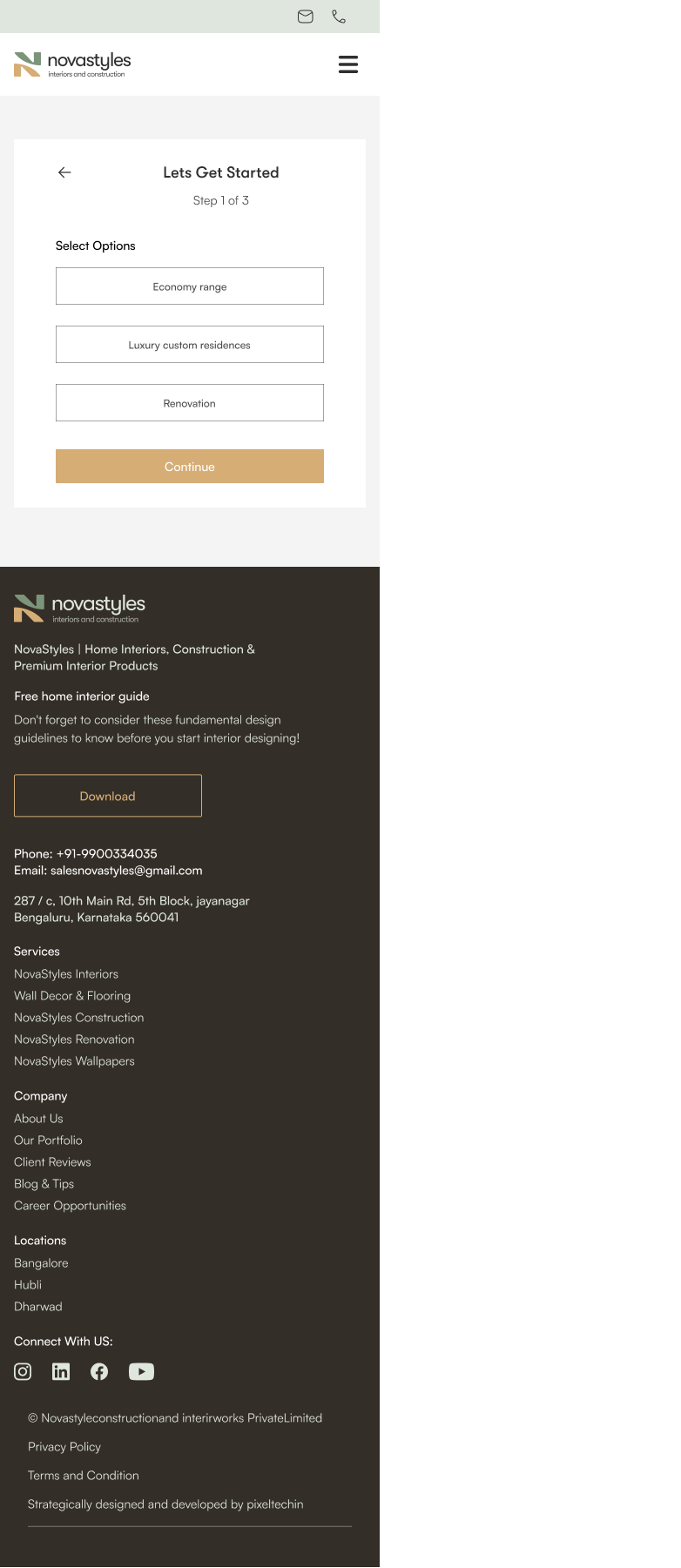
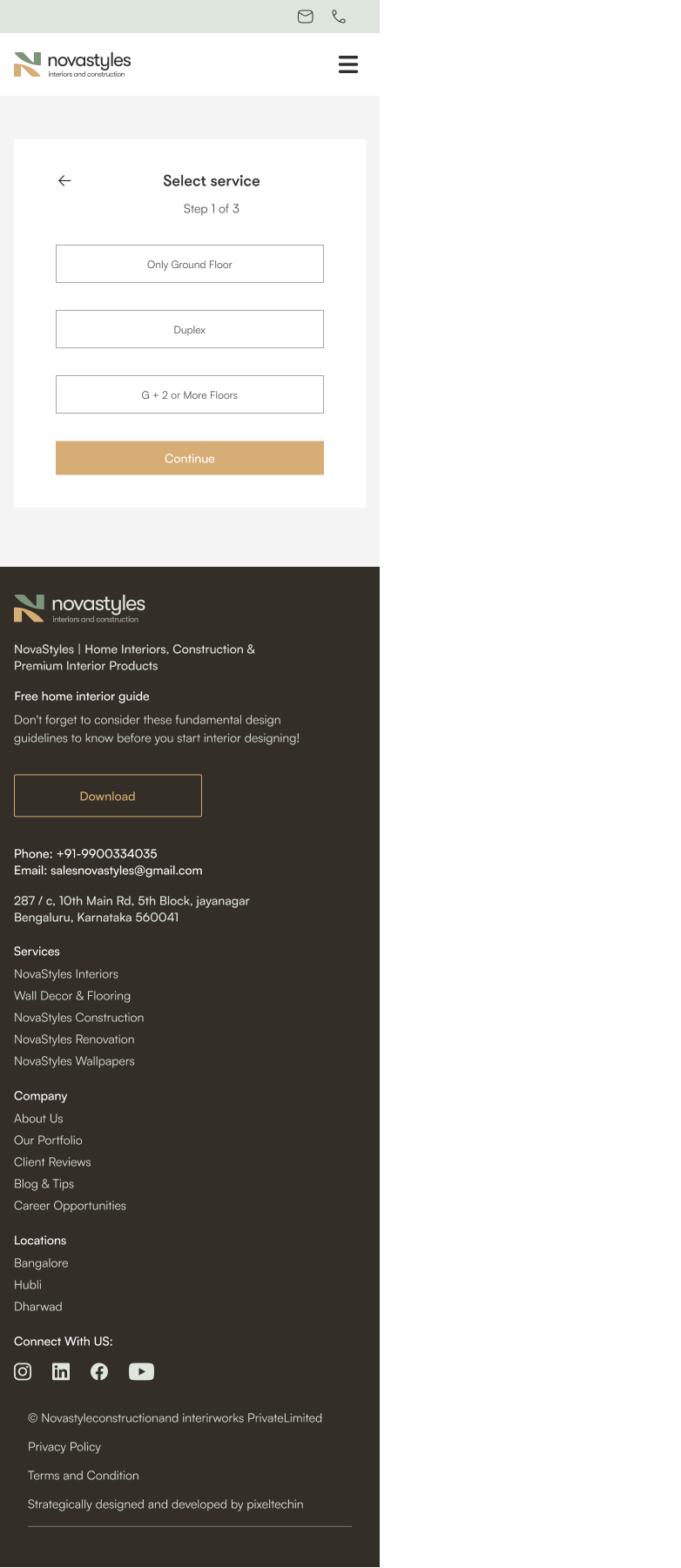
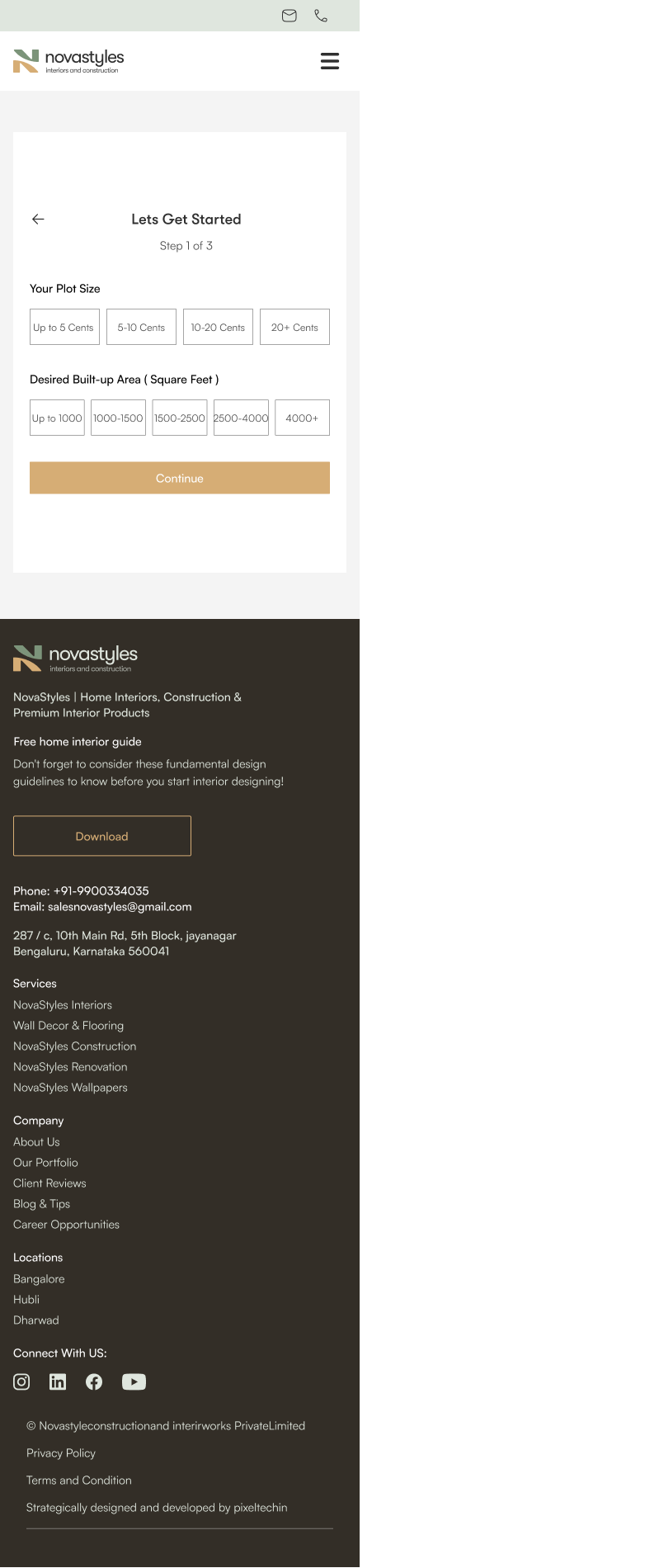
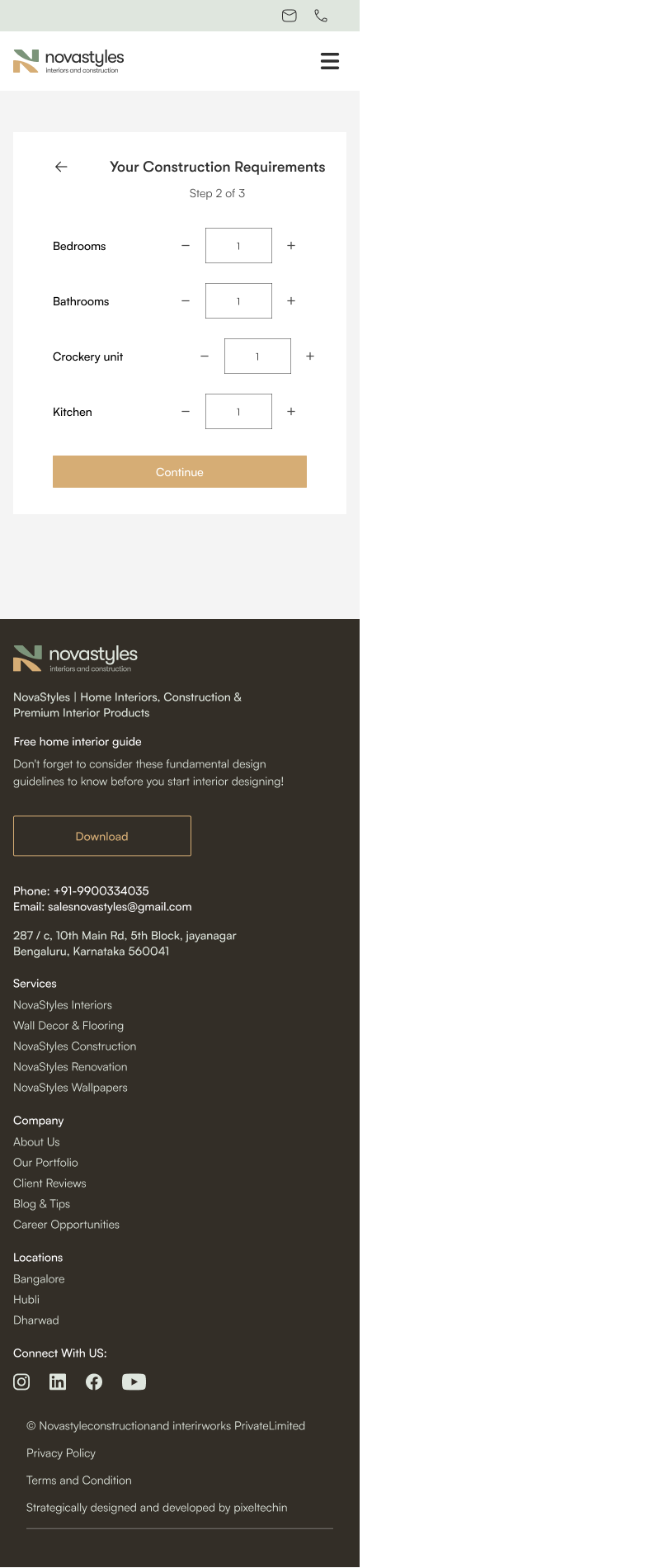
The 3-step estimation flow is the core conversion mechanism. Step 1 asks users to select their interest (Economy, Luxury, Renovation for interiors; Building Type for construction). Step 2 captures specifications (plot size, built-up area, room requirements). Step 3 delivers tiered pricing — Basic (₹37L), Standard (₹48.5L), and Premium (₹68L) — with clear feature and warranty differences.

Estimation Step 1 — Select Options
Step 1
Select service type
Estimation Step 2 — Building Type
Step 2
Building type & area
Estimation Step 3 — Specifications
Step 3
Room requirements
Estimation Step 4 — Contact Info
Step 4
Contact details
Estimation Result — Tiered Pricing
Result
Tiered pricing estimates

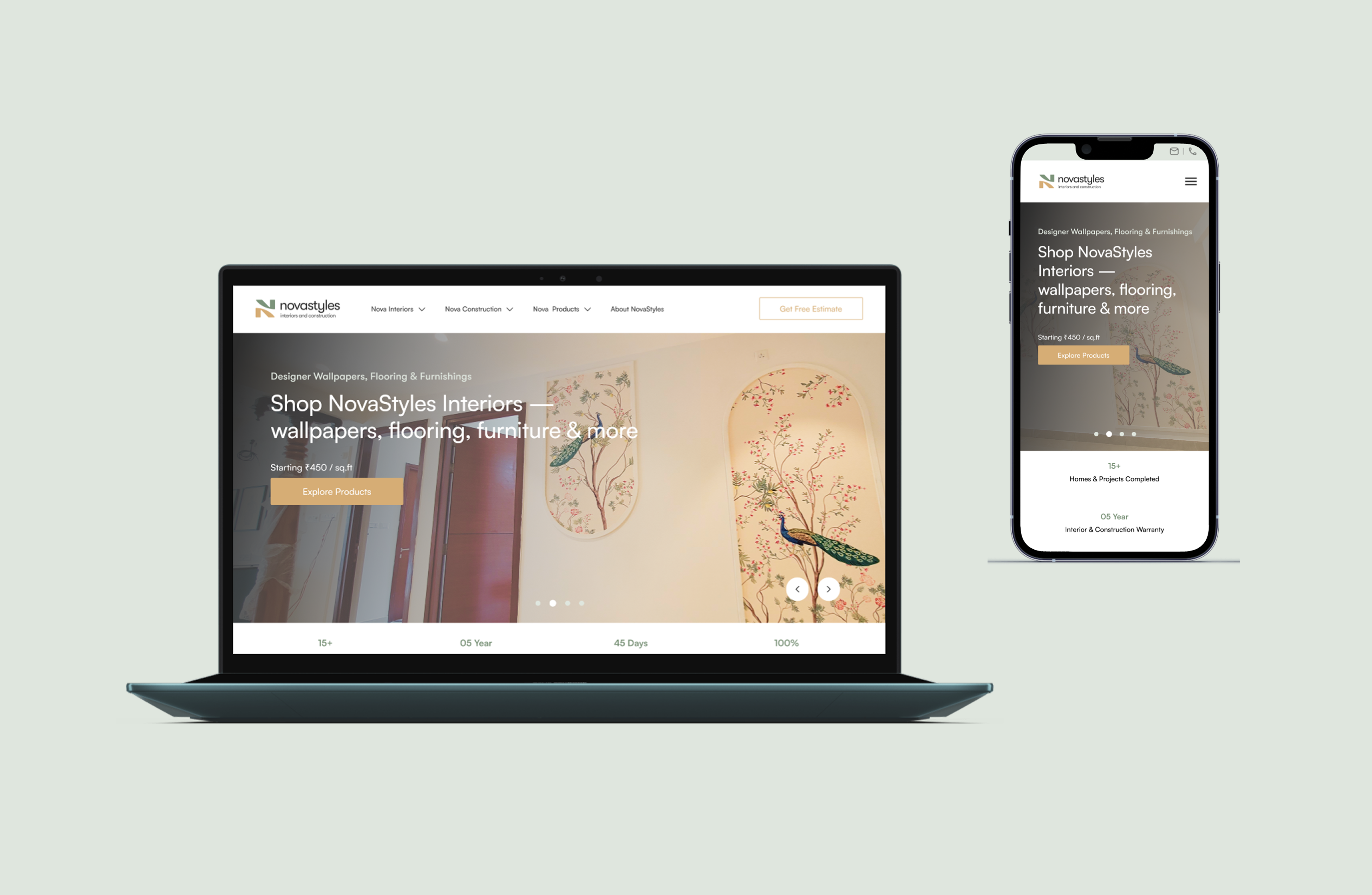
Responsive Design — Desktop & Mobile

Every screen was designed for both desktop and mobile viewports. The estimation flow, product pages, and service landings all adapt gracefully to smaller screens. The mobile navigation collapses into a hamburger menu while preserving the intent-based structure. Complex product configurators scale down without losing functionality.

NovaStyles — Responsive Design Overview

What the redesign achieved

The platform went from a basic informational website to a structured, conversion-focused ecosystem. Every design decision was backed by competitor research and real user feedback — not assumptions.

30+ Screens designed across desktop and mobile
3 Distinct service verticals with dedicated UX flows
120+ Competitor reviews analyzed to inform design decisions

From information to conversion

The old website was a digital brochure. The new platform has clear conversion paths for each service vertical — guided estimation flows that capture user intent, specifications, and contact info in a structured way that helps the sales team prioritize and respond faster.

Research-led, not assumption-led

By analyzing 120+ real user reviews from competitors, the design addressed actual pain points — pricing transparency (#1 complaint), response time (#2 complaint), and multi-service convenience (#3 request). This isn't a redesign based on "best practices" — it's based on evidence.

The platform's job is to match user intent to the right conversion path — interiors, construction, or products — within the first 3 seconds.

That was the core design principle. Every navigation, layout, and flow decision came back to this idea.
Next project View all projects